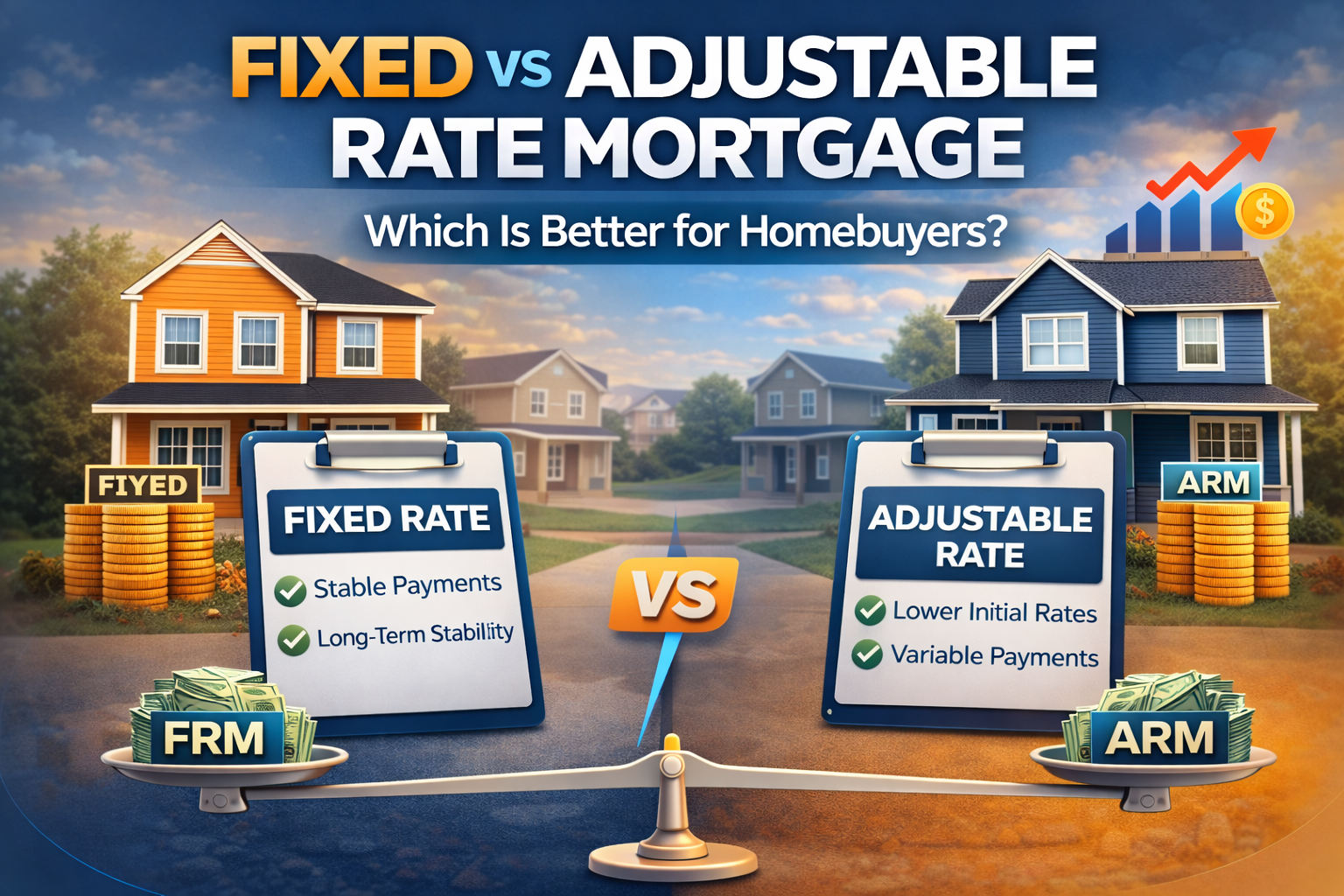
When buying a home or refinancing a mortgage, one of the biggest decisions borrowers face is choosing between a Fixed-Rate Mortgage (FRM) and an Adjustable-Rate Mortgage (ARM).
Both options come with their own advantages and risks. The best choice depends on several factors such as your financial goals, how long you plan to stay in the home, and your comfort level with interest rate changes.
Understanding how these two mortgage types work can help you choose the option that best fits your budget and long-term housing plans.
What Is a Fixed-Rate Mortgage?
A fixed-rate mortgage is a home loan where the interest rate remains the same for the entire loan term.
Whether the loan term is 15 years, 20 years, or 30 years, the monthly principal and interest payments stay consistent throughout the life of the loan.
Example
If you take a 30-year fixed mortgage at 6% interest, your interest rate will remain 6% for the entire 30 years.
Advantages of Fixed-Rate Mortgages
1. Predictable Monthly Payments
Because the interest rate never changes, homeowners know exactly how much they will pay every month.
2. Protection From Rising Interest Rates
If market interest rates increase in the future, your mortgage rate remains unchanged.
3. Easier Budgeting
Stable payments make financial planning easier, especially for long-term homeowners.
Disadvantages of Fixed-Rate Mortgages
1. Higher Initial Interest Rates
Fixed mortgages usually start with slightly higher interest rates compared to adjustable-rate loans.
2. Less Flexibility if Rates Fall
If interest rates drop significantly, homeowners may need to refinance to benefit from lower rates.
Fixed-rate mortgages are commonly chosen by borrowers who want long-term stability and predictable housing costs.
What Is an Adjustable-Rate Mortgage?
An adjustable-rate mortgage (ARM) is a home loan where the interest rate can change over time based on market conditions.
Most ARMs start with a fixed introductory period, typically 3, 5, 7, or 10 years. After that period ends, the interest rate adjusts periodically—usually once per year.
Example: 5/1 ARM
- First 5 years → Fixed interest rate
- After year 5 → Interest rate adjusts annually
Advantages of Adjustable-Rate Mortgages
1. Lower Starting Interest Rates
ARMs usually offer lower initial rates than fixed-rate mortgages.
2. Lower Initial Monthly Payments
Because the starting rate is lower, monthly payments are typically smaller during the introductory period.
3. Good for Short-Term Homeowners
If you plan to sell or refinance before the adjustable period begins, you may save money.
Disadvantages of Adjustable-Rate Mortgages
1. Payment Uncertainty
After the initial period, the interest rate may increase, raising monthly payments.
2. Risk of Higher Long-Term Costs
If market rates rise significantly, mortgage payments can become much higher.
3. Harder Financial Planning
Variable payments make budgeting more complicated.
ARMs are usually chosen by borrowers who expect lower rates in the short term or plan to move before the adjustment period begins.
Key Differences Between Fixed and Adjustable Mortgages
| Feature | Fixed-Rate Mortgage | Adjustable-Rate Mortgage |
|---|---|---|
| Interest Rate | Stays the same | Changes after fixed period |
| Monthly Payment | Stable and predictable | Can increase or decrease |
| Initial Interest Rate | Usually higher | Usually lower |
| Long-Term Risk | Low | Higher if rates rise |
| Best For | Long-term homeowners | Short-term homeowners |
Example Payment Comparison
Imagine borrowing $300,000 for a home loan.
| Mortgage Type | Interest Rate | Monthly Payment (Approx.) |
|---|---|---|
| 30-Year Fixed Mortgage | 6.5% | ~$1,896 |
| 5/1 ARM | 5.5% initial | ~$1,703 |
In this example, the ARM saves about $190 per month during the initial fixed period. However, payments may increase once the adjustable phase begins.
When a Fixed-Rate Mortgage Is Better
A fixed-rate mortgage may be the better option if:
- You plan to stay in the home long-term
- You want predictable monthly payments
- You prefer financial stability
- You expect interest rates to increase in the future
Many first-time homebuyers choose fixed mortgages because they provide long-term payment certainty.
When an Adjustable-Rate Mortgage Is Better
An adjustable-rate mortgage might be better if:
- You plan to sell or refinance within a few years
- You want lower initial monthly payments
- You expect interest rates to remain stable or decrease
- You are comfortable with some financial risk
ARMs can be attractive for buyers who expect to move before the interest rate adjustment occurs.
Factors to Consider Before Choosing
Before selecting a mortgage type, consider these important factors.
1. How Long You Plan to Stay
If you plan to stay in the home for decades, fixed mortgages often make more sense.
2. Interest Rate Trends
If rates are historically low, locking in a fixed rate may be beneficial.
3. Financial Stability
If your income may fluctuate, fixed payments may provide better financial security.
4. Risk Tolerance
Adjustable mortgages carry more risk because payments may rise.
Conclusion
Both fixed-rate mortgages and adjustable-rate mortgages offer advantages depending on your financial situation and long-term plans.
Fixed-rate mortgages provide:
- Stability
- Predictable monthly payments
- Protection from rising interest rates
Adjustable-rate mortgages offer:
- Lower initial interest rates
- Smaller early payments
However, they also carry the risk of higher payments later.
For most long-term homeowners, fixed-rate mortgages provide greater financial security. On the other hand, ARMs can be beneficial for borrowers who expect to move or refinance within a few years.
Choosing the right mortgage requires careful evaluation of your financial goals, housing plans, and comfort with interest rate changes.
FAQs
1. Which mortgage is safer: fixed or adjustable?
Fixed-rate mortgages are generally safer because the interest rate never changes.
2. Why are adjustable-rate mortgages cheaper at first?
They start with lower introductory rates to attract borrowers before the adjustable period begins.
3. Can I refinance an adjustable-rate mortgage later?
Yes. Many borrowers refinance before the adjustable rate period begins.
4. What is the most common mortgage type?
The 30-year fixed-rate mortgage is the most common home loan in many countries.
5. Is an ARM risky?
An ARM can carry risk because the interest rate may increase after the fixed introductory period, which can raise monthly payments.